
In this article:
- Why should washrooms be part of the October budgeting conversation?
- How can ESG become an expense saver rather than an expense line?
- What should a credible washroom business case include?
- Let’s look at the real numbers and ROI in the UAE, SSA and UK
- Which toilet and urinal technologies should be budgeted for?
- How does HydroConnect strengthen ROI and ESG evidence?
- How can organisations phase an upgrade yet start saving immediately?
- Where can facility managers experience the full Contour range?
- Final thought
As budget season begins, invest wisely for 2027 by prioritising water-saving solutions that deliver immediate, permanent reductions in water consumption and operating costs for years to come. Commercial washrooms are often overlooked, yet water saving toilets, low or zero water urinals and connected monitoring can measurable return on investment and credible evidence for ESG reporting.
Why should washrooms be part of the October budgeting conversation?
Budgeting season usually concentrates attention on visible priorities: energy, staffing, security, digital systems and planned maintenance. Toilets and urinals rarely receive the same scrutiny because they are treated as routine plumbing rather than an asset or an opportunity to improve financial and environmental performance.
That is a costly oversight. Every flush creates water and wastewater charges. When an inefficient fixture is used repeatedly across a busy office, shopping centre, hospital, university, airport or public building, a small volume of waste becomes a substantial annual expense. Commercial bathroom water conservation is therefore a practical method of reducing recurring expenditure. Efficient sanitaryware delivers savings through the asset itself every day the building operates.
For executives, this means a washroom upgrade can be assessed in familiar commercial terms:
- What is the current annual water and wastewater cost?
- How much consumption could be avoided?
- What is the expected annual financial saving?
- How long is the estimated payback period?
- What maintenance costs or operational problems could also be reduced?
- How will the result be measured and reported?
When the answers are supported by credible baseline data, a sustainable washroom project becomes easier to compare with other capital priorities.
Use the Propelair Water Savings Calculator to test your starting assumptions, then contact Propelair to discuss a site-specific commercial washroom assessment.
TOP TIP FOR FACILITY MANAGERS
Ask finance for the last 12 months of water and wastewater charges before preparing the washroom budget. Using the organisation’s actual tariff creates a more credible business case than relying on a generic industry average.
How can ESG become an expense saver rather than an expense line?
ESG is still sometimes viewed as a reporting obligation or a cost that competes with operational priorities. Water efficiency challenges that assumption because the same intervention can reduce environmental impact and lower expenditure at the same time.
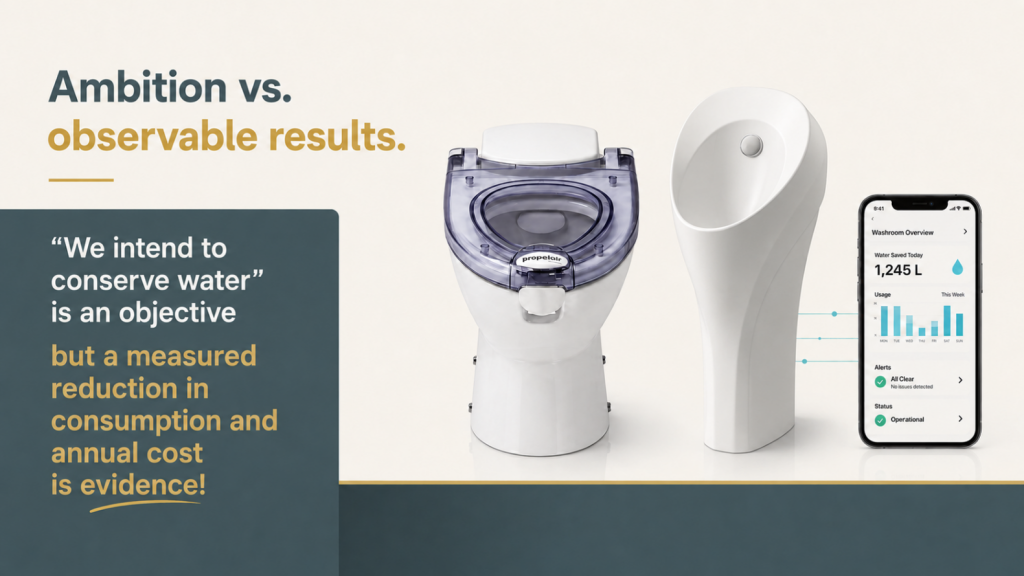
The most convincing ESG initiatives connect ambition to observable results. “We intend to conserve water” is an objective but a measured reduction in consumption and annual cost is evidence.
This is particularly important as stakeholders ask organisations to substantiate environmental claims. Sustainable water management should therefore be built into the budget with three linked measures:
- the environmental baseline, including current water consumption;
- the financial baseline, including water, wastewater and maintenance costs; and
- the verification method that will demonstrate performance after installation.
When these measures are agreed at the start, ESG becomes a disciplined programme for reducing waste, managing risk and improving cost efficiency.
TOP TIP FOR FACILITY MANAGERS
Give every proposed ESG project at least one environmental measure and one financial measure. For a washroom upgrade, litres saved and annual cost avoided provide a clear starting pair.
What should a credible washroom business case include?
A credible proposal begins with the building, not the product. Sites have different occupancy, tariffs, infrastructure and maintenance challenges. A transport hub cannot be modelled like a small office, while a multi-site estate may need a phased plan.
Facility managers should record:
- the number and type of toilets and urinals;
- current flush volumes;
- estimated or measured uses per asset per day;
- building operating days per year;
- local water and wastewater tariffs;
- recurring blockages, leaks, call-outs and downtime;
- planned refurbishments that could reduce installation disruption; and
- internal ESG, water-resilience and cost-reduction targets.
Propelair’s Water Savings Calculator turns several of these inputs into an initial estimate. It uses current flush volume, daily flushes, annual operating days, the number of toilets and the metered water charge to estimate annual litres saved, financial savings, percentage water reduction, associated carbon reduction and payback.
The calculator is a starting point for testing assumptions, comparing scenarios and identifying buildings with the strongest potential return. A detailed assessment can then consider site conditions, maintenance, installation and the appropriate product mix.
Get instant insight with the Propelair Water Savings Calculator.
TOP TIP FOR FACILITY MANAGERS:
Run three scenarios, conservative, expected and high usage. A proposal that still performs under conservative assumptions is more likely to withstand financial scrutiny.
Let’s look at the real numbers and ROI in the UAE, SSA and UK
Projected savings are useful for budgeting, but completed installations show what efficient sanitation can achieve in real commercial and public facilities. Propelair’s case study library provides examples across its main regions, including the UAE, Sub-Saharan Africa and the UK.
UAE: VOX Cinemas, Mall of the Emirates
VOX Cinemas at the Mall of the Emirates replaced 40 conventional toilets with Propelair OneThreeFive technology. Annual washroom water use fell from approximately 15.2 million litres to 3.2 million litres, a 79% reduction and a saving of 12.05 million litres per year. The site also recorded annual water utility savings of AED 134,904 and a payback period of just 1.4 years.
A water-saving investment in a high-footfall entertainment environment produced recurring operating savings, reduced carbon emissions by approximately five tonnes annually and delivered a clearly defined financial return. Read the VOX Cinemas case study.
SSA: Nedbank, South Africa
At Nedbank’s high-occupancy office buildings, Propelair toilets reduced consumption by approximately 75%. Annual water use fell from about 60.28 million litres to 15.07 million litres, saving approximately 45.21 million litres per year. The investment achieved full payback in under 2.5 years, while the recorded reduction in water demand also supported the organisation’s ESG objectives.
The value comes from repeating each fixture’s efficiency across many assets and thousands of daily uses. Read the Nedbank case study.
UK: Cardiff University
At Cardiff University’s McKenzie House, outdated 13-litre toilets were replaced with Propelair 1.5-litre systems. Toilet water consumption fell by approximately 90%, saving about 5.26 million litres and £16,366 annually. The project achieved a reported payback period of 2.3 years.
Older sanitaryware can create a substantial water and cost reduction opportunity for education, government and commercial estates. Read the Cardiff University case study.
Results differ because every site has its own baseline, usage and tariff. The common lesson is that water efficient sanitation solutions can be measured in litres, currency and payback.
Which toilet and urinal technologies should be budgeted for?
The best water saving toilets for businesses depend on water targets, infrastructure, footfall, maintenance needs and the visibility required. But how would you know which water savings sanitaryware is really best for your facility?
The Propelair OneThreeFive toilet uses 1.35 litres per flush and is designed for high-use commercial and public environments. Facilities seeking commercial water efficient toilets should consider water performance and whole-life operational requirements.
The wider Contour product range [ZG1] allows organisations to consider the entire washroom rather than toilets alone:
- Contour Pro combines a 1.5-litre air-assisted flush with connected monitoring, blockage detection and maintenance alerts. It is suited to facilities that require IoT connected toilets and better asset visibility.
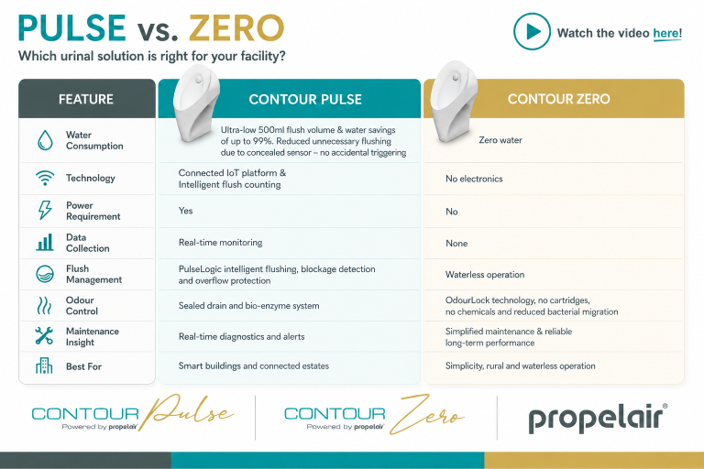
- Propelair Contour Pulse is a smart urinal that uses a 500 ml flush. Its sensor and PulseLogic control help avoid unnecessary flushing, while connectivity supports remote monitoring and performance information.
- Propelair Contour Zero is a waterless urinal. Its OdourLock one-way drain technology is designed to prevent drainage odours without cartridges, chemicals, electronics or power.
Facilities can therefore choose between an intelligent low flush urinal and a zero water urinal. A connected urinal suits buildings where data and maintenance visibility matter. A commercial waterless urinal may be preferable where eliminating flushing water or simplifying operation is the priority.
The strongest commercial washroom water saving strategy may combine high efficiency toilets, water saving urinals and waterless washroom solutions to achieve the best whole-building result.
TOP TIP FOR FACILITY MANAGERS
Divide the estate into building or washroom types before specifying products. Grouping sites by footfall, infrastructure and maintenance requirements makes it easier to choose the right solution and phase the budget intelligently.
How does HydroConnect strengthen ROI and ESG evidence?
Efficient ceramics create savings, but connected technology can make those savings easier to manage and demonstrate. HydroConnect brings compatible Contour products into a measured ecosystem, helping facility teams move beyond isolated assets towards a more informed view of washroom performance.
Connected washroom monitoring can show what happens after installation, helping teams understand usage, asset performance and maintenance needs without waiting for a user to report a problem.
For a multi-site facility management team, the potential benefits include:
- clearer visibility across connected washroom assets;
- measurable information to support water and ESG reporting;
- faster identification of faults or maintenance needs;
- improved planning of technician and cleaning resources;
- performance comparisons across buildings or locations; and
- stronger evidence for future capital allocation.
Within a Propelair connected washroom ecosystem, a toilet or IoT urinal can contribute information that helps teams save, manage and prove performance.
TOP TIP FOR FACILITY MANAGERS:
Decide at budget stage who will own the data after installation. Agree which measures will be reviewed, how often they will be reported and what action should follow an alert or performance change.
How can organisations phase an upgrade yet start saving immediately?
A full portfolio rollout may not fit into one budget cycle. A well-designed pilot in a representative, busy location can produce evidence for the next phase.
A practical phased approach could include:
- Audit existing toilets, commercial urinals and waterless sanitaryware.
- Establish current water, cost and maintenance baselines.
- Use the calculator to identify high-opportunity buildings.
- Select one representative, high-use washroom for a measured pilot.
- Review water savings, operating performance and user experience.
- Use the evidence to build the next budget submission.
This approach lets executives assess investment against defined measures and helps facility teams validate installation requirements. It can reveal whether the larger opportunity lies in smart water saving toilets, an automatic flush urinal, a sensor operated urinal, a flushless urinal or a blended solution.
TOP TIP FOR FACILITY MANAGERS:
Choose a pilot location with meaningful footfall and reliable baseline data. A rarely used washroom will take longer to demonstrate the operational and financial effect of an efficient fixture.
Where can facility managers experience the full Contour range?
Facility managers, sustainability professionals, property owners and executives attending the Green Building Council South Africa’s Green Building Convention can explore the full Propelair Contour range from 27 to 29 October 2026 at the Century City Conference Centre in Cape Town.
The event provides a practical opportunity to examine how ultra-low-flush toilets, the Contour Pulse smart urinal, the Contour Zero waterless urinal and HydroConnect can work together. Visitors can discuss their existing washroom challenges, test the assumptions behind a potential business case and consider which combination of products may suit their estate.
Bring useful information with you: the number of assets, existing flush volumes, estimated usage, water tariffs and known maintenance issues for a conversation based on real building savings will be more valuable to you than a general product discussion.
TOP TIP FOR FACILITY MANAGERS:
Book time with the relevant internal decision-makers shortly after the Convention while the information and October planning window are still current!
Final thought
The washroom may not be the most visible item in the annual budget, but it can be one of the most measurable. Every unnecessary litre has a cost, and every efficient flush creates a saving that can be repeated across assets, buildings and years. When efficient ceramics are combined with the right technology and credible performance data, ESG becomes more than an expense. It becomes a practical route to lower operating costs, stronger resilience and evidence-based investment.
Use the Propelair Water Savings Calculator to test your starting assumptions, then contact Propelair to discuss a site-specific commercial washroom assessment.
By: Zea Gove, Global Brand and Marketing support
