
In this article:
- Why Are Accurate Water-Saving Calculations So Important?
- What Does a Free Propelair Site Survey Include?
- From Sustainability Ambition to a Measurable Business Case
- How Does the Propelair Purchase and Installation Process Work?
- What Technical Checks Are Completed Before Installation?
- How Does Propelair Reduce the Risk of Investing?
- Can Measurable Washroom Savings Be Achieved in Practice?
- Turn Hidden Water Consumption Into Visible Savings
Water-saving projects often begin with a promising estimate. The real challenge comes when facilities, finance or procurement teams ask the questions that matter:
- How much water will we actually save?
- What and when will the financial return be?
- Will the proposed solution work with our existing washroom infrastructure?
Propelair’s free, no-obligation site survey is designed to answer these questions with accurate, site-specific evidence. Instead of relying on general assumptions, industry averages or vague sustainability promises, we assess your facilities, measure existing consumption and build a detailed business case around the way your washrooms are used.
The result is a clear understanding of the potential water savings, annual cost reductions, expected payback period and most suitable Propelair solution for your organisation. No guesswork. No vague promises. Just credible numbers that show exactly what your organisation could save.
Why Are Accurate Water-Saving Calculations So Important?
Commercial washrooms can consume a significant proportion of a building’s water, particularly in offices, shopping centres, hospitals, universities, transport hubs and other high-footfall environments.
Despite this, many organisations do not know how much water their toilets and urinals use each year. Consumption is often hidden within a broader utility bill, making it difficult to identify the financial effect of outdated or inefficient washroom equipment. A general calculation can offer a useful starting point. However, a strong investment decision requires more than a broad estimate.
Actual savings can be influenced by:
- The number and type of toilets on site
- Existing flush volumes
- The frequency with which each toilet is used
- Building occupancy
- The number of operational days per year
- Local water and wastewater tariffs
- Existing plumbing and drainage
- Installation requirements
- The Propelair product selected
Propelair’s free site survey considers these variables to provide a realistic assessment of the opportunity available within your building. This gives facilities teams reliable information, finance teams a measurable financial case and sustainability teams credible data that can support environmental reporting.
What Does a Free Propelair Site Survey Include?
The purpose of the survey is to establish whether a site is suitable for Propelair technology and to calculate the potential benefits as accurately as possible. Our team assesses the washroom environment, existing sanitaryware and relevant infrastructure. We also collect the data required to calculate current and projected water use.
The survey enables Propelair to determine:
- Potential water savings: We establish how much water the existing toilets consume and compare this with the consumption expected from the most appropriate Propelair solution. This shows the potential reduction in litres, both per toilet and across the wider installation.
- Annual cost reductions: Water savings are translated into financial savings using the organisation’s applicable water and wastewater charges. This allows decision-makers to understand the potential effect on annual operating costs, rather than considering the project purely as a sustainability expense.
- Expected payback: The projected annual savings are compared with the cost of the proposed installation. This produces a practical payback calculation, helping procurement and finance teams assess the commercial value of the project and prioritise investment.
- The most suitable Propelair solution: Not every building is identical. Usage levels, plumbing arrangements, operational pressures and sustainability objectives vary. The site survey helps our team recommend the Propelair solution best suited to the individual facility instead of approaching every project with a standard specification.
From Sustainability Ambition to a Measurable Business Case
Many organisations have committed to reducing water consumption, improving resource efficiency and strengthening their environmental performance. The difficulty is turning those ambitions into projects that can secure internal approval.
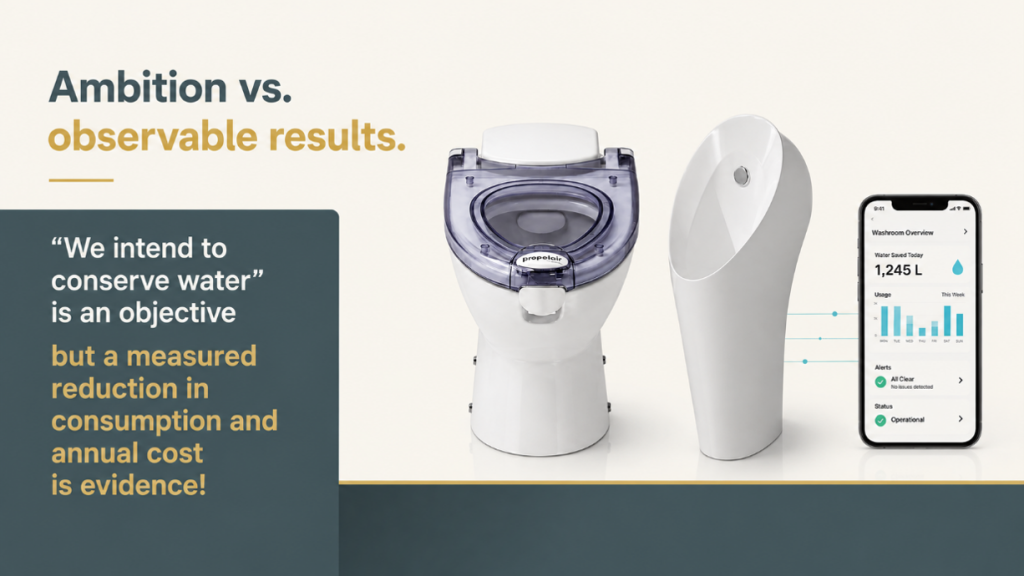
A proposal stating that new washroom technology “should save water” is unlikely to satisfy finance teams or senior decision-makers. They need to know how much water could be saved, what that saving is worth and when the original investment is likely to be recovered.
The Propelair survey converts an environmental objective into a numbers-based business case.
Your report is built around your:
- Facilities
- Washroom assets
- Usage patterns
- Existing consumption
- Local water costs
- Operational requirements
This provides a more credible basis for budgeting, procurement and ESG decision-making. It also helps different departments evaluate the project using the measures that matter to them:
- Facilities managers can assess suitability and operational performance.
- Finance teams can consider annual savings and payback.
- Sustainability teams can identify a measurable reduction in resource consumption.
- Senior executives can evaluate the broader commercial and environmental value.
How Does the Propelair Purchase and Installation Process Work?
Propelair uses a structured process that begins with understanding the site and continues through installation, measurement and verification.
Step 1: Get in touch: The process begins when you contact the Propelair team.
We register your interest, discuss your requirements and enter your organisation into our free business case process. There is no obligation to proceed with an installation after the initial assessment.
Step 2: Complete the site survey: Once your interest has been registered, our engineers arrange a visit to your facility.
They conduct a detailed assessment of the washrooms and examine the existing infrastructure. This helps confirm the site’s suitability and identifies any technical considerations that should be addressed before installation.
Step 3: Measure current usage: We measure how much water your washrooms currently use.
This is a vital part of the process because the accuracy of any projected saving depends on the quality of the baseline data. Where relevant, energy use and other operational factors may also be considered.
By establishing the existing position, Propelair can calculate the difference that an upgrade could make.
Step 4: Prepare your quotation and business case: The information collected during the survey is used to prepare a tailored quotation and evidence-based business case.
This sets out:
- Existing water consumption
- Projected consumption after installation
- Potential annual water savings
- Estimated annual financial savings
- Expected investment payback
- Recommended products
- Proposed installation requirements
The business case gives your internal stakeholders the information they need to make an informed decision.
Step 5: Confirm the installation
If you are satisfied with the proposal, the Propelair team will work with you to agree on an installation date and implementation plan. The installation can be planned around the operational needs of the building, helping to minimise disruption to employees, tenants, customers or visitors.
Step 6: Install, measure and support
Propelair’s trained installers complete the installation according to the agreed specification. Our installation capability supports customers internationally, enabling organisations across different regions to access the same structured process, technical knowledge and product support. The work does not end when the equipment is installed. We re-survey performance after installation to confirm that the anticipated savings are being achieved.
Step 7: Verify and commission
The final stage is verification and commissioning. Our team checks that the products are operating correctly and confirms that the organisation is receiving the expected performance and benefits. This closes the gap between projected savings and actual results. The objective is not simply to install a product, but to help the customer achieve a verified reduction in consumption.
What Technical Checks Are Completed Before Installation?
The site survey is also an important technical safeguard. Before installation, Propelair confirms that appropriate electrical and water connections are available. The team also assesses the drainage arrangement to establish whether it complies with applicable local regulations and is suitable for the proposed installation.
These checks allow potential issues to be identified early and incorporated into the project plan. This provides greater clarity around installation requirements, reduces the likelihood of unexpected complications and helps ensure that the recommended solution is suitable for the building.
Propelair products must be fitted by trained and recommended installers because correct assessment and installation are important to performance and warranty requirements.
How Does Propelair Reduce the Risk of Investing?
Predicted savings are only valuable if the installed products deliver them.
Our calculations are not presented as loose marketing estimates. They are based on the information collected from the site and the performance expected from the proposed system. Propelair stands behind the calculated performance of its technology. If the calculated water savings are not achieved within the first three months of installation, Propelair offers to credit the cost of one installed product, subject to the applicable terms.
The three-month measurement period also gives the organisation an early opportunity to compare actual performance with the original business case.
Can Measurable Washroom Savings Be Achieved in Practice?
Propelair installations have already demonstrated the value of replacing assumptions with measured outcomes.
- At Siemens’ Midrand campus in South Africa, 112 Propelair toilets reduced washroom water consumption by 85%, saving approximately 5.46 million litres annually and supporting the organisation’s Net Zero goals.
- At Thames Water’s Clearwater Court headquarters, 44 Propelair toilets reduced water consumption by 79%. The installation saves approximately 3.9 million litres and £8,387 in water costs each year.
- At the London Borough of Redbridge, 45 toilets deliver more than 5.3 million litres in annual water savings, with an expected payback period of approximately 1.9 years per unit.
These outcomes differ because every facility has its own baseline consumption, occupancy, tariffs and operating conditions. That is precisely why a site-specific assessment matters. The question is not simply what Propelair has saved somewhere else. The important question is what it could save at your facility.
Turn Hidden Water Consumption Into Visible Savings
An inefficient toilet may flush thousands of times each year. Multiply that consumption across an entire building or property portfolio, and a seemingly small volume per flush can become a significant operational expense.
Propelair’s free site survey makes that hidden cost visible. It gives your organisation a practical opportunity to investigate water efficiency without committing to a purchase. You receive a clear assessment of the potential savings, installation requirements, recommended solution and likely financial return.
If your organisation is reviewing utility costs, preparing budgets, developing a water-reduction strategy or looking for measurable ESG initiatives, the survey provides a credible place to begin.
You do not need to guess how much water your washrooms could save. Let us measure it.
Book your free, no-obligation Propelair site survey today and receive an evidence-based business case showing your potential water savings, annual cost reductions and expected payback.
By: Zea Gove, Global Brand and Marketing support
