
In this article:
- Why are commercial washrooms becoming connected ecosystems?
- 1. How can efficient sanitation technology SAVE water, cost and resources?
- Top tip for facility managers:
- 2. How can connected sanitation technology help facilities MANAGE washrooms better?
- Top tip for facility managers:
- 3. How can a connected washroom help organisations PROVE ROI and ESG performance?
- Top tip for facility managers:
- Final thought:
Efficient sanitation technology is essential because modern commercial and public washrooms need to do more than simply function. They need to save resources, be actively managed and provide measurable evidence of their performance.
That requires a shift from thinking about toilets, urinals and taps as individual pieces of sanitaryware to viewing the washroom as a connected ecosystem.
For facility managers, building owners and sustainability teams, the washroom opportunity can be summarised in three words:
SAVE: Optimise water, cost and resources across the entire washroom.
MANAGE: Connect assets to detect problems, reduce downtime and manage facilities proactively.
PROVE: Turn washroom performance into measurable data that demonstrates savings, ROI and ESG impact.
This is where efficient sanitation technology is heading, and why Propelair is developing its Contour range around the concept of the Connected Washroom.
Why are commercial washrooms becoming connected ecosystems?
For decades, plumbing and facility management have largely treated washroom products as separate assets. A toilet flushes. A urinal flushes. A tap delivers water. Maintenance teams intervene when something stops working.
But this approach misses the bigger opportunity.
A commercial washroom can contain dozens, or across a property portfolio, thousands of water-consuming assets. Individually, improving each fixture delivers a benefit. Collectively, connecting efficient products and their performance data can fundamentally change how the facility is managed.
Instead of asking whether a particular toilet or urinal saves water, facility managers can begin asking better questions:
How efficiently is the entire washroom operating? Where is water being consumed? Which assets require attention? What are we saving? And can we prove it?
That is the difference between a collection of sanitaryware and a connected washroom ecosystem.
1. How can efficient sanitation technology SAVE water, cost and resources?
Water efficiency starts with the physical products. Commercial buildings need to reduce unnecessary potable water consumption without compromising performance, hygiene or the user experience. This makes water saving toilets, low flush toilets, water efficient urinals and waterless urinals increasingly important components of sustainable washroom design.
Propelair approaches this challenge across multiple washroom assets.
The Propelair OneThreeFive toilet uses ultra-low-flush, air-assisted technology to dramatically reduce the volume of water required for each flush compared with conventional toilets. Propelair’s wider toilet technology also combines water efficiency with smart functionality, including IoT connectivity, blockage detection and maintenance diagnostics.
This makes the technology particularly relevant where organisations are looking for commercial water efficient toilets, high efficiency toilets for commercial washrooms and practical ways to achieve commercial toilet water savings.
The same principle applies to urinals. The Propelair Contour Pulse is a smart urinal designed specifically for commercial and public washrooms. It uses just 500 ml of water per flush, compared with typical low-flush urinals using around 1.5 to 3 litres. Its intelligent system does not simply trigger a flush after every user. A concealed sensor and advanced algorithm determine when flushing is actually required, helping to reduce unnecessary water consumption.
For facilities considering an IoT urinal, connected urinal or intelligent urinal system, Contour Pulse combines ultra-low water use with remote monitoring and performance visibility.
Then there is another approach entirely: eliminate flushing water.
The Propelair Contour Zero is a commercial waterless urinal requiring no flushing water. Designed without cartridges or chemicals, it provides facilities with an alternative for locations where eliminating urinal water consumption altogether is the priority.
Together, these technologies illustrate an important principle in commercial bathroom water conservation: maximum efficiency rarely comes from addressing one fixture in isolation.
The goal should be to reduce washroom water consumption across the whole environment.
What does this mean for facilities?
Using efficient toilet and urinal technology can help organisations:
- reduce potable water consumption;
- reduce commercial water bills and sewerage costs;
- improve washroom water efficiency;
- reduce demand on water infrastructure;
- support sustainable water management; and
- strengthen environmental and ESG performance.
For high-footfall facilities, small reductions per use become significant when multiplied across hundreds or thousands of daily washroom visits.
Top tip for facility managers:
Don’t assess water-saving technology only by litres per flush. Calculate consumption using flush volume × actual usage × number of assets × operating days. This gives you a much more realistic picture of annual water and cost-saving potential.
See how this works in practice by exploring Propelair’s real-world commercial installations and water-saving case studies.
2. How can connected sanitation technology help facilities MANAGE washrooms better?
Saving water is only part of the opportunity. One of the biggest changes taking place in facility management is the transition from reactive maintenance to data-led asset management.
In a busy airport, shopping centre, hospital, university, office building or transport hub, a failed toilet or blocked urinal is more than an inconvenience. It can quickly affect hygiene, user experience, cleaning requirements and maintenance workloads. Traditional facility management often relies on someone noticing the problem and reporting it. Connected washroom technology changes this model.
Propelair’s approach combines intelligent sanitaryware with connectivity, giving facility teams greater visibility of asset performance and helping them respond to problems based on actual conditions. The Contour Pulse, for example, combines its 500 ml flush with built-in IoT connectivity, enabling real-time remote monitoring across individual or multiple sites and supporting predictive, data-driven maintenance.
Similarly, Propelair’s connected toilet technology can provide maintenance diagnostics and blockage alerts. The result is a smart connected commercial washroom where assets increasingly communicate their condition instead of silently waiting to fail. This matters enormously when managing large estates. Imagine being responsible for washrooms across 20, 50 or 100 buildings. Physically inspecting every asset frequently is resource intensive. Equally, waiting for failures before deploying maintenance teams can increase downtime and cost.
A connected ecosystem gives facility managers the opportunity to move towards:
- real-time asset monitoring;
- remote and multi-site visibility;
- blockage and fault notifications;
- smarter maintenance scheduling;
- usage-based decision-making;
- better deployment of technicians and cleaning teams; and
- reduced reactive maintenance.
This is where plumbing technology and facility management increasingly intersect.
The toilet or urinal is no longer simply a plumbing fixture. It becomes an asset capable of contributing operational information to the wider building management strategy.
Why does this matter financially? Maintenance has a cost beyond replacement parts. Every unnecessary inspection, reactive call-out, repeated blockage and unavailable washroom consumes staff time and operational resources. Connected technology can help facility managers understand where attention is actually required, allowing resources to be allocated more intelligently. For organisations investigating commercial washroom cost savings, therefore, water consumption should not be the only line on the business case. Operational efficiency matters too.
Top tip for facility managers:
When evaluating smart washroom technology, ask what happens after installation. Look for systems that provide actionable information rather than simply collecting data. Useful technology should help your team decide what requires attention, where and when.
3. How can a connected washroom help organisations PROVE ROI and ESG performance?
Perhaps the most important development in efficient sanitation technology is that savings no longer need to remain theoretical.
Facility managers are increasingly expected to demonstrate the return generated by sustainability investments.
How much water was saved?
How much money was saved?
Is the equipment performing as expected?
Where should the organisation invest next?
And what evidence supports the environmental claims being made?
This is where connected products and washroom monitoring become particularly valuable.
When toilets, smart urinals and other washroom assets operate as part of an integrated ecosystem, usage and performance information can create a much clearer picture of what is happening across a facility or property portfolio. Propelair’s Connected Washroom strategy is designed to transform commercial washrooms from collections of passive fixtures into intelligently managed assets through integrated sanitaryware and real-time oversight.
That data can help organisations establish a reliable source of information for:
- water consumption and savings;
- asset usage;
- maintenance requirements;
- operational performance;
- ROI calculations;
- sustainability reporting; and
- future investment decisions.
This changes the conversation around sustainable washroom solutions. Instead of saying, “We installed water-efficient products,” an organisation can increasingly demonstrate what those products are actually achieving. That distinction is becoming particularly important for ESG.
Environmental commitments carry significantly more weight when they are supported by measurable operational performance. Data allows sustainability teams to move from estimates and assumptions towards evidence. It also allows finance and procurement teams to compare investment against measurable outcomes.
For facility managers, this creates something equally valuable: one source of truth. Rather than managing toilets, urinals and washroom assets as isolated components, connected technology can create a facility-wide view of usage, water savings, performance and maintenance requirements.
Top tip for facility managers:
Establish your baseline before upgrading your washrooms. Record existing flush volumes, estimated or measured usage, water and sewerage tariffs, maintenance call-outs and recurring faults. Without a credible baseline, proving the ROI of an efficiency project later becomes much harder.
View the data behind this through Propelair’s case studies, where commercial and public facilities demonstrate measurable reductions in water consumption, costs and environmental impact. Why is a mixture of low-water and zero-water technology important?
There is no single sanitation solution that will be perfect for every location. A high-traffic airport has different requirements from an office building. A water-stressed region may prioritise absolute consumption reduction, while a large multi-site estate may place greater value on visibility and predictive maintenance. That is why an ecosystem approach matters.
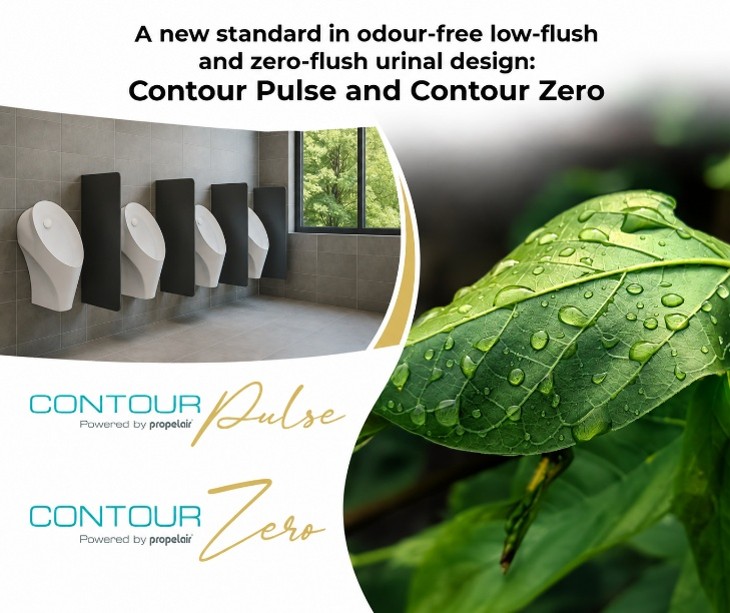
- A low water urinal such as Contour Pulse may be appropriate where facilities want intelligent flushing, IoT connectivity and ongoing performance data.
- A zero water urinal such as Contour Zero may be more appropriate where eliminating urinal flushing water altogether is the priority.
- Similarly, smart water saving toilets can dramatically reduce toilet consumption while introducing functionality that supports modern facility management.
The question therefore changes from: “Which is the most efficient product?” to: “Which combination of efficient sanitation
technologies will deliver the best outcome for this building?” That is a far more useful question for architects, plumbing consultants, facility managers, sustainability professionals and commercial property owners.
Is efficient sanitation technology becoming essential rather than optional? Increasingly, yes. Commercial buildings face growing pressure to reduce resource consumption while maintaining reliable, hygienic and efficient facilities. Water scarcity, infrastructure pressure, utility costs and ESG expectations are making commercial building water conservation a strategic issue rather than simply a plumbing consideration.
The washroom represents an unusually practical opportunity because consumption happens repeatedly, every day. A litre saved once is a litre. A litre saved thousands of times across multiple fixtures, buildings and years becomes a measurable resource strategy. This is why the next generation of water efficient sanitation solutions needs to combine physical efficiency with intelligence.
- Efficient products SAVE.
- Connected technology helps facilities MANAGE.
- Data allows organisations to PROVE the outcome.
Together, these three capabilities create something much more valuable than individual pieces of sanitaryware: a connected washroom ecosystem.
Final thought:
The future of the commercial washroom is not simply about using less water. It is about knowing where resources are being used, how assets are performing, where intervention is required and what the investment is achieving. For plumbing and facility management professionals, this represents a fundamental change in how washrooms should be designed and operated.
Propelair’s Contour range brings together ultra-low-water toilets, the Contour Pulse smart water saving urinal, the Contour Zero waterless urinal and connected technology to help turn the washroom into a measurable, actively managed asset. Because the smartest washroom is not simply the one that uses less. It is the one that can save, manage and prove it.
Ready to explore what a connected, water-efficient washroom could deliver for your facilities? Contact Propelair to discuss your water, operational and sustainability objectives.
By: Zea Gove, Global Brand and Marketing support
